AI Visibility Report: 23 Indian Health & Nutrition Brands Across AI Answer Engines
Pallix analyzed 23 Indian health and nutrition brands across buyer-intent AI discovery prompts. The report shows which brands appear in ChatGPT, Perplexity, and Google AI Overviews, and why third-party proof is becoming central to AI discovery.
A buyer no longer needs to search Google, open five tabs, and compare products manually.
They can ask ChatGPT, Perplexity, or Google AI Overviews the kind of questions buyers actually type:
Buyer prompts
- "Rs 2000 mein kaunsa whey protein acha hai?"
- "Best protein bars with no added sugar"
- "collagen ke liye kaunse brands compare karun?"
The answer can place a brand into the buyer’s shortlist before the buyer ever visits a website.
To understand how this is already playing out in India, Pallix analyzed 23 Indian health, nutrition, functional food, and better-for-you D2C brands across broad buyer-intent discovery prompts.
The main finding was simple:
AI visibility is not just a website problem. It is a source-ecosystem problem.
A readable website matters. But in broad discovery prompts, AI engines repeatedly leaned on third-party proof: marketplaces, YouTube, Reddit, publisher roundups, review pages, and category comparison sources.
Executive summary
Across the 23 audit snapshots:
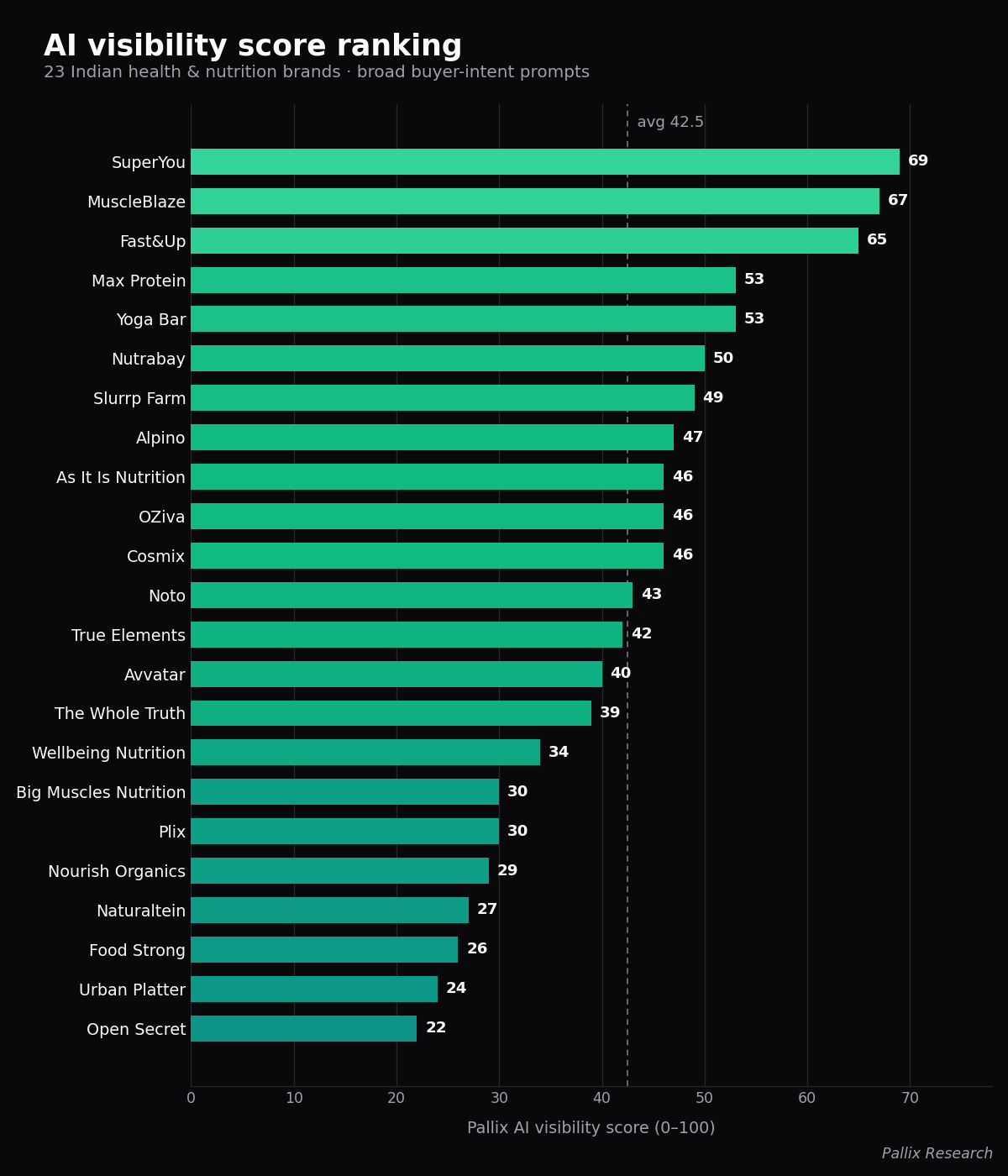
- The average AI visibility score was 42.5/100.
- Only 6 of 23 brands scored 50 or higher.
- Brands appeared in 404 of 682 broad-discovery prompt slots.
- The average mention rate was 46.7%.
- The median AI visibility score was 43/100.
- SuperYou had the highest overall score at 69/100.
- MuscleBlaze had the highest mention rate at 84% and appeared in 29/30 discovery prompts.
- Fast&Up had the strongest average discovery position among the top brands at #1.5.
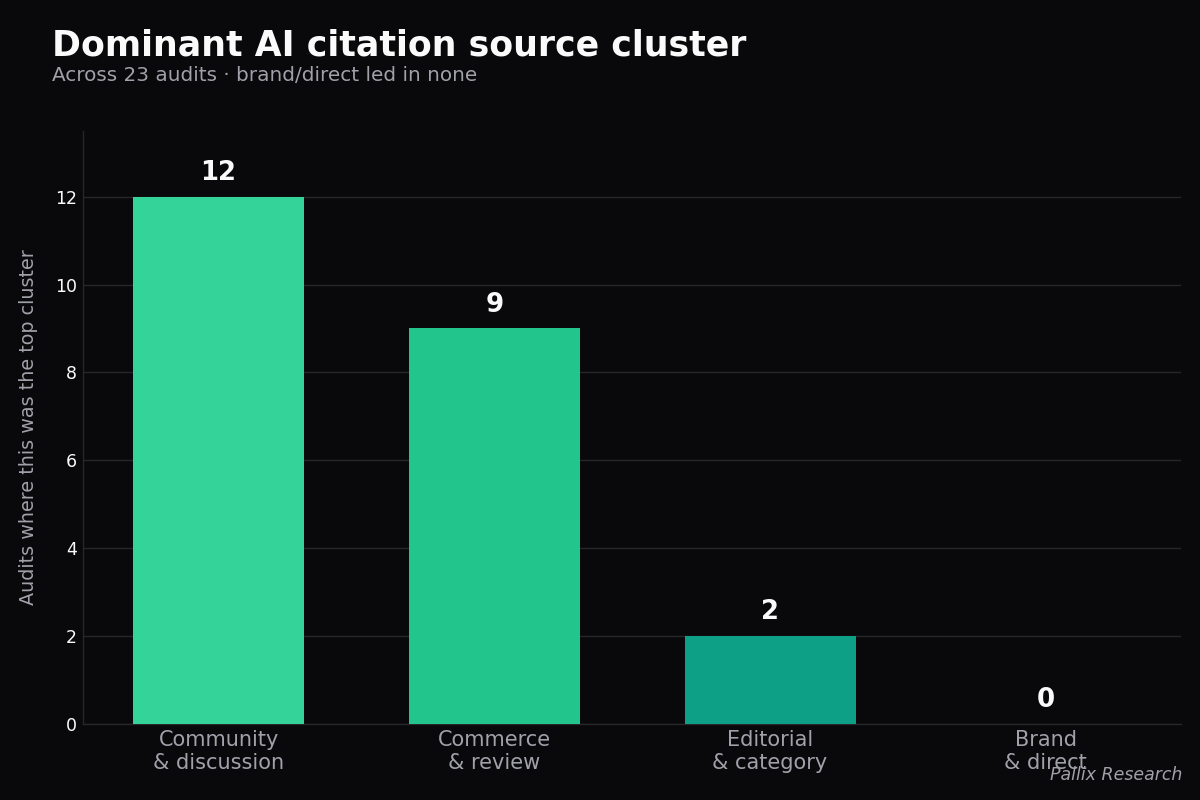
- In the source-cluster analysis, brand/direct sources were not the dominant source cluster in any of the 23 snapshots.
That last point is the most important one. Your own website still matters, but AI engines often form recommendations from the broader web around your brand.
The scorecard
The table below ranks the 23 audited brands by Pallix AI visibility score. The score is a normalized discovery score, not market share. It reflects how often a brand appeared, where it appeared, and how strongly it showed up across broad buyer-intent prompts.
| Rank | Brand | AI visibility score | Mention rate | Discovery prompts visible | Avg. position | Technical readiness |
|---|---|---|---|---|---|---|
| 1 | SuperYou | 69 | 81% | 26/30 | #1.9 | 62/100 - Weak |
| 2 | MuscleBlaze | 67 | 84% | 29/30 | #2.5 | 79/100 - Moderate |
| 3 | Fast&Up | 65 | 70% | 25/30 | #1.5 | 87/100 - Strong |
| 4 | Max Protein | 53 | 64% | 24/30 | #2.1 | 3/100 - Critical |
| 5 | Yoga Bar | 53 | 65% | 25/30 | #2.7 | 0/100 - Critical |
| 6 | Nutrabay | 50 | 56% | 24/30 | #3.3 | 87/100 - Strong |
| 7 | Slurrp Farm | 49 | 56% | 16/20 | #3.6 | 74/100 - Moderate |
| 8 | Alpino | 47 | 53% | 22/30 | #2.9 | 74/100 - Moderate |
| 9 | As It Is Nutrition | 46 | 52% | 21/30 | #2.8 | 69/100 - Moderate |
| 10 | OZiva | 46 | 53% | 21/30 | #2.9 | 82/100 - Moderate |
| 11 | Cosmix | 46 | 48% | 18/30 | #2.2 | 87/100 - Strong |
| 12 | Noto | 43 | 49% | 20/30 | #3.2 | 67/100 - Moderate |
| 13 | True Elements | 42 | 48% | 22/30 | #2.9 | 77/100 - Moderate |
| 14 | Avvatar | 40 | 45% | 21/30 | #3.4 | 58/100 - Weak |
| 15 | The Whole Truth | 39 | 42% | 17/30 | #2.5 | 62/100 - Weak |
| 16 | Wellbeing Nutrition | 34 | 35% | 12/30 | #2.3 | 77/100 - Moderate |
| 17 | Big Muscles Nutrition | 30 | 32% | 11/30 | #3.0 | 87/100 - Strong |
| 18 | Plix | 30 | 29% | 11/30 | #2.9 | Not shown in export |
| 19 | Nourish Organics | 29 | 28% | 11/30 | #4.0 | 77/100 - Moderate |
| 20 | Naturaltein | 27 | 24% | 7/30 | #3.0 | 87/100 - Strong |
| 21 | Food Strong | 26 | 21% | 6/30 | #1.2 | 74/100 - Moderate |
| 22 | Urban Platter | 24 | 22% | 7/30 | #5.0 | 64/100 - Moderate |
| 23 | Open Secret | 22 | 16% | 8/32 | #3.0 | 77/100 - Moderate |
Three things stand out.
First, the category has no runaway winner. Even the leading brand, SuperYou, scored 69/100. That means there is still open surface area in AI search.
Second, presence and position are not the same thing. MuscleBlaze had the highest mention rate and broadest prompt coverage, while SuperYou led the normalized score. A brand needs to know not only whether it was mentioned, but where it appeared inside the answer.
Third, technical readiness alone did not decide the ranking. Some brands with strong technical readiness still had weak broad discovery, while some brands with crawler issues still appeared often because the broader web was already talking about them.
Finding 1: brand recall is not the same as broad discovery
A brand can be known and still lose discovery.
A prompt like:
"Is OZiva good?"
is a brand-recall prompt. The buyer already knows the brand.
A prompt like:
"Best plant protein for easy digestion"
is a broad-discovery prompt. The buyer has not chosen a brand yet.
That second moment is more competitive. It is where AI decides which brands enter the shortlist.
In this sample, many brands had some category awareness but weaker broad discovery. Urban Platter, Naturaltein, Food Strong, Open Secret, Plix, and Nourish Organics were not invisible as brands, but they struggled to become default recommendations in broad buyer prompts.
This is the AI-search equivalent of ranking for your own brand name but not ranking for the category.
Finding 2: third-party proof shaped the answer
The strongest pattern across the audits was the role of third-party sources.
| Dominant source cluster | Audits where this was the top cluster |
|---|---|
| Community & discussion | 12 |
| Commerce & review | 9 |
| Editorial & category | 2 |
| Brand & direct | 0 |
This does not mean official brand websites are unimportant. They are still the cleanest place for AI to verify product details, claims, ingredients, pricing, FAQs, and positioning.
But when AI systems chose between brands in broad discovery prompts, they often leaned on sources that looked more comparative or neutral.
Repeated source surfaces included:
- Community and discussion: YouTube, Reddit, forums, and social video.
- Commerce and review: Amazon.in, BigBasket, HealthKart, 1mg, marketplace listings, and review pages.
- Editorial and category: Hindustan Times, NDTV, MensXP, Healthshots, MyUpchar, BodybuildingIndia, FitLifeRegime, and category roundups.
- Brand/direct: official brand websites and product pages.
The practical implication is clear:
If AI cannot find useful third-party validation for your brand, your website alone may not be enough to win broad recommendation prompts.
Finding 3: the technical paradox
Two patterns appeared at the same time.
Some brands had strong visibility despite weak technical readiness. Max Protein scored 53/100 with a 64% mention rate despite critical technical readiness. Yoga Bar also scored 53/100 with a 65% mention rate, while the audit flagged that GPTBot was blocked or not clearly allowed.
That does not mean crawler access is irrelevant. It means AI can still learn about a brand from marketplaces, reviews, YouTube, Reddit, and publisher pages.
But that creates a control problem. If the official website is not easy to read, AI may rely more heavily on third-party pages to describe the brand. That can affect product claims, pricing, comparisons, and accuracy.
The reverse also appeared. Naturaltein and Big Muscles Nutrition had strong technical readiness scores of 87/100, but their AI visibility scores were 27 and 30. A clean website is the foundation, not the full strategy.
AI visibility needs both:
- a readable official site, and
- credible third-party proof across the sources AI already uses.
Finding 4: buyer prompts are specific, not generic
The losing prompts were rarely broad SEO keywords. They looked like real buyer questions:
- "Best whey protein with good mixability"
- "Rs 2000 mein kaunsa whey protein acha hai?"
- "Best oats under Rs 750"
- "Best protein bars with no added sugar"
- "Which sugar free ice cream is worth buying under Rs 300?"
- "collagen ke liye kaunse brands compare karun?"
- "What are good nuts and seeds options under Rs 300?"
- "Best plant protein for easy digestion"
- "Best pancake mixes for quick breakfast"
This matters because many brand websites still behave like product catalogs.
AI prompts are not catalog queries. They are decision moments. They include price, use case, taste, ingredients, category comparisons, and Hinglish phrasing.
A brand that wants to appear in these answers needs pages and proof that map to how buyers actually ask.
Where the opportunity is hiding
Instead of listing 23 separate brand action items, the audits point to three repeatable opportunity patterns.
| Opportunity pattern | Where it showed up | What brands should do |
|---|---|---|
| Performance nutrition is won on comparison surfaces | Whey protein, creatine, mass gainer, pre-workout, protein-per-serving, and mixability prompts | Build credible presence on category comparison pages, marketplaces, creator reviews, Reddit discussions, and fitness/nutrition publishers. |
| Better-for-you snacks need commerce and creator proof | Protein bars, oats, cookies, granola, protein puffs, breakfast mixes, and clean-ingredient snack prompts | Strengthen marketplace listings, review depth, creator-led proof, and product comparison content around price, taste, ingredients, and use case. |
| Specialized categories need authority proof | Collagen, plant protein, sugar-free ice cream, nuts and seeds, electrolyte tablets, and functional nutrition prompts | Earn mentions on trusted health, wellness, retail, and community sources where buyers already compare options. |
This is the operational shift: from keyword targeting to source-surface targeting.
A whey protein brand should not only write a blog on "best whey protein." It should understand whether AI is relying on HealthKart, Reddit, MensXP, Hindustan Times, BodybuildingIndia, or marketplace reviews for that prompt.
A snack brand should understand whether the answer is being shaped by Amazon, BigBasket, Flipkart, YouTube, NDTV, or food-review pages.
A collagen or sugar-free dessert brand should understand whether AI is pulling from health publishers, commerce pages, or community discussions.
What brands should do next
1. Make the official site easy for AI to read
Important product and category information should be available in crawlable HTML, not hidden behind scripts, image-only layouts, or tabs that render poorly. Brands should use clear headings, product summaries, FAQs, comparison sections, and structured data where relevant.
2. Build content around buyer prompts
Instead of only publishing generic blogs, brands should answer practical questions:
- best whey protein under Rs 2000,
- best protein bar under Rs 100,
- best oats for quick breakfast,
- best collagen supplement under Rs 1000,
- best sugar-free ice cream under Rs 300.
The goal is not to spam keyword pages. The goal is to answer real buying questions with useful product details, tradeoffs, comparisons, and proof.
3. Win the sources AI already cites
If AI is citing HealthKart, BigBasket, Amazon, 1mg, YouTube, Reddit, Hindustan Times, NDTV, MyUpchar, or BodybuildingIndia for your category, you need credible presence there.
That can come from accurate listings, strong reviews, creator explainers, comparison videos, useful Reddit discussions, editorial mentions, and category guides.
This should not be done through spam backlinks or artificial guest-post networks. The evidence has to be useful, specific, and consistent.
4. Track prompts, competitors, and citations together
Traditional SEO tracks keywords and rankings. AI visibility needs a different dashboard:
- Which prompts mention your brand?
- Which prompts mention competitors instead?
- What is your average position inside the answer?
- Which sources are being cited?
- Which product claims are repeated?
- Which answers are inaccurate, negative, or risky?
A brand can improve its website and still lose if competitors are earning better third-party proof. Prompt tracking and citation tracking need to happen together.
Methodology
This report is based on 23 Pallix AI visibility audit snapshots for Indian health, nutrition, functional food, and better-for-you brands.
Brands included: Alpino, As It Is Nutrition, Avvatar, Big Muscles Nutrition, Cosmix, Fast&Up, Food Strong, Max Protein, MuscleBlaze, Naturaltein, Noto, Nourish Organics, Nutrabay, Open Secret, OZiva, Plix, Slurrp Farm, SuperYou, The Whole Truth, True Elements, Urban Platter, Wellbeing Nutrition, and Yoga Bar.
The audits were generated between 3 May 2026 and 22 May 2026. The uploaded snapshots covered 682 broad-discovery prompt slots across the 23 reports. Most brands were tested against 30 discovery prompts; two report exports had different prompt counts.
The audits measured mention rate, discovery prompts visible, average discovery position, flagged AI answers, AI visibility score, technical readiness, source clusters, competitor recommendations, tone/framing, and priority discovery gaps.
Surfaces included ChatGPT and Perplexity across the snapshots, with Google AI Overviews included in most reports.
This is a point-in-time analysis. AI answers change frequently as models, sources, rankings, product pages, and public discussions change.
Conclusion
The strongest conclusion from the 23 audits is that AI discovery is not decided by a brand website alone.
A brand needs a readable official site, but it also needs evidence across the sources AI systems already use to answer buyer questions.
The brands that won were not only the brands with product pages. They were the brands that appeared in the wider source ecosystem: YouTube, Reddit, marketplace listings, comparison pages, editorial roundups, and category-specific guides.
For Indian D2C brands, the next SEO frontier is not just ranking in Google. It is becoming the brand that AI systems confidently recommend when buyers ask what to buy.
That is the gap Pallix is built to track.
Cite this report
If you reference this research, please cite:
Pallix Research. "AI Visibility Report: 23 Indian Health & Nutrition Brands Across AI Answer Engines." May 2026.
Run your own AI visibility audit
Pallix helps Indian brands track how they appear across AI answer engines, which competitors are being recommended instead, and which sources are shaping those answers.